How to Scout Public Land for Deer: A Complete Whitetail Scouting Guide
Learn how to scout public land for whitetails by finding bedding, food, travel routes, fresh sign, and hunting pressure. This guide breaks down how to find better deer hunting spots and hunt them effectively.
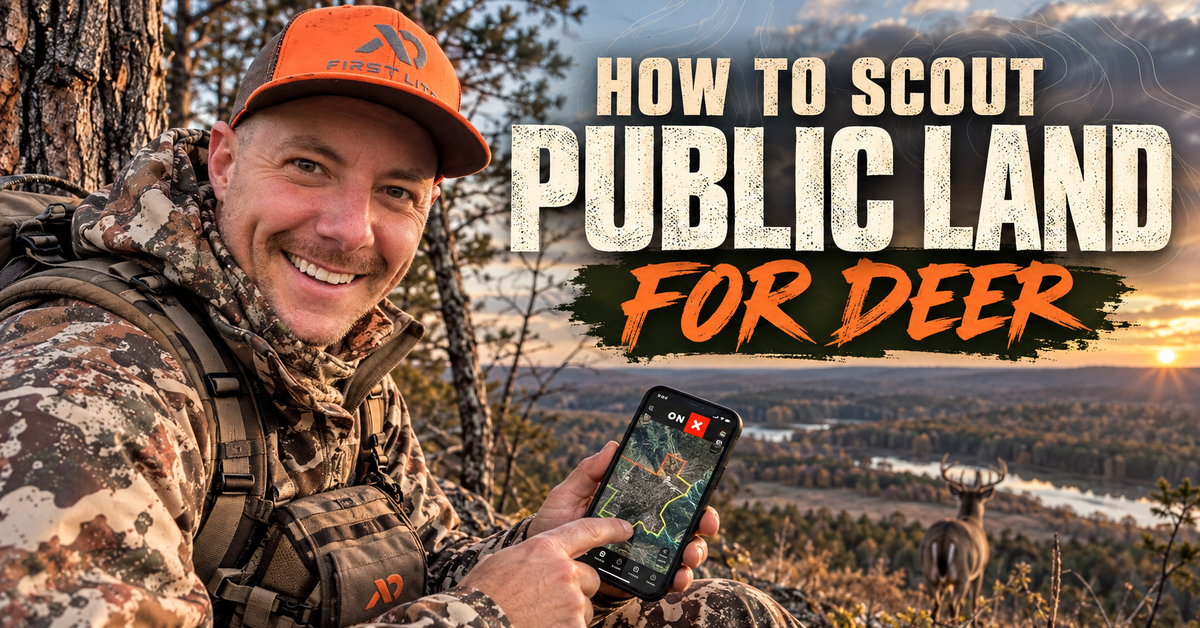
How to Scout Public Land for Deer: A Complete Whitetail Scouting Guide
Hunting whitetails on public land is different.
You are not the only person looking for deer. You are dealing with other hunters, unpredictable pressure, limited access, and deer that learn very quickly where people like to go.
That is exactly why scouting public land matters so much.
Finding a good public land deer hunting spot is not about walking through the woods until you find a pile of tracks, a big rub, or a tree that looks comfortable to sit in.
You need to understand how deer use the property, how hunters use the property, and where those two things intersect.
You are looking for bedding, food, travel routes, terrain features, fresh sign, good access, and favorable wind. But on public land, you also need to think about parking lots, property boundaries, hiking trails, other hunters, and overlooked areas where deer can escape pressure.
The goal is not simply to find deer sign.
The goal is to find deer sign you can actually hunt without blowing the deer out.
Here is how I approach scouting public land for whitetails.
Use onX and E-Scouting Before You Enter the Woods
Good public land scouting should start at home.
Before burning gas and walking five miles through a property, spend some time studying it digitally.
One of my favorite tools for doing this is onX Hunt.
I use onX to study public land boundaries, access points, satellite imagery, topography, surrounding private property, roads, water, and potential areas worth scouting before I ever put boots on the ground.
If you have never used it, you can try onX Hunt free for a week here.
Your goal during this first stage is not to pick the exact tree you are going to hunt.
You are eliminating ground.
Start by identifying:
- Public access points
- Parking areas
- Roads and trails
- Property boundaries
- Rivers and creeks
- Agricultural fields
- Clear cuts
- Swamps and marshes
- Thick cover
- Ridges
- Points
- Saddles
- Drainages
- Habitat transitions
Then zoom out.
This is important.
Do not study only the 40 acres surrounding a spot that looks good. Look at the entire public property and the surrounding landscape.
Where are the major food sources?
Where is the nastiest security cover?
Where are the roads?
Where is the private property?
Where are most hunters likely to enter?
Then ask yourself:
If I were a mature buck trying to live here without constantly running into people, where would I go?
Start dropping potential waypoints in onX, but do not treat them as confirmed hunting spots.
They are theories.
Your job when you enter the woods is to prove or disprove them.
Understand What Deer Actually Need
You can make deer hunting incredibly complicated, but a whitetail's basic needs are simple.
They need food.
They need security.
And they need to move between the two.
When scouting public land for deer, you are trying to understand those three things.
Find the Food
Food sources change throughout the season.
Depending on where you hunt, deer could be feeding on:
- Agricultural crops
- Acorns
- Browse
- Fruit trees
- Clear cuts
- Young forest regeneration
- Food plots
- Native grasses and plants
Do not assume a field automatically makes a great hunting spot.
A big agricultural field might attract 20 deer every night while providing almost no hunting opportunity during legal shooting hours.
Instead, ask:
Where are these deer coming from before they reach the food?
Work backward from the food source toward likely bedding and security cover.
That transition between bedding and destination food can be much more valuable than the food source itself.
Find Security and Bedding Cover
Bedding is security.
During daylight hours, especially on heavily pressured public land, mature deer want to spend time where they feel protected.
Look for thick cover, isolated points, swamp islands, cattail edges, brushy clear cuts, overgrown fields, ridge points, creek bottoms, blowdowns, and other areas that give deer an advantage.
A buck does not necessarily need an impenetrable fortress.
He needs an advantage.
That might come from wind, elevation, visibility, thick cover, water, difficult access, or simply distance from human activity.
Connect Bedding to Food
Once you identify likely bedding and food, figure out how deer can travel between them.
Look for:
- Funnels
- Pinch points
- Creek crossings
- Saddles
- Fence gaps
- Inside corners
- Habitat edges
- Benches
- Narrow strips of timber
Whenever several possible travel routes get squeezed into one smaller area, you have something worth investigating.
Learn to Identify Buck Bedding
Finding bedding is one of the most valuable skills you can develop as a public land deer hunter.
You are not necessarily trying to sit directly over a buck's bed.
You are trying to understand where that buck feels safe during daylight.
A good buck bedding area will often provide some combination of security cover, wind advantage, visibility, multiple escape routes, and low human pressure.
When you find a bed, do not just look at the flattened leaves.
Look around.
Where is the wind coming from?
What can the deer see from that location?
What is behind it?
Where would the deer go if something approached?
What trail leaves the area?
Where does that trail eventually lead?
If you find a larger isolated bed accompanied by big tracks, rubs, or a heavily used trail, pay attention.
Mark it on onX.
Take a few notes.
Then get out.
You do not need to walk circles around a suspected buck bed looking for one more piece of evidence. Every additional step spreads more scent and increases the chance that you educate the deer you eventually want to hunt.
Fresh Sign Matters More Than Lots of Sign
One of the easiest mistakes to make when scouting public land is getting excited about old deer sign.
A giant rub is exciting.
So is a heavily worn trail.
But neither automatically means deer are using that location right now.
Learn to separate historical sign from current sign.
Look for:
- Fresh tracks
- Fresh droppings
- Recently worked scrapes
- Fresh rubs
- Active browse
- Recently used beds
Tracks can be especially valuable.
Pay attention to their size and direction.
One track tells you a deer walked through an area.
Multiple tracks, beds, rubs, and trails pointing toward the same destination start telling you a story.
That story is what you are looking for.
Rubs and Scrapes Are Clues, Not Guaranteed Hunting Spots
Hunters love finding rubs and scrapes.
I do too.
But do not hang a stand over every scrape you find.
A rub tells you a buck was there.
A scrape tells you deer are communicating there.
Neither tells you exactly when the deer was there.
A giant scrape 200 yards from a parking lot might get destroyed every night at 2:00 a.m.
That does not help you much.
Context matters.
If you find fresh rubs connecting thick bedding cover to a feeding area, that becomes more interesting.
If several rubs form a line, figure out where that line goes.
If multiple active scrapes are located near a funnel, bedding area, or staging area, investigate further.
Individual pieces of sign matter less than the story they tell together.
On Public Land, Scout the Hunters Too
This might be the biggest difference between scouting private and public land.
You are not only scouting deer.
You are scouting people.
Look for boot tracks.
Look for reflective trail markers.
Look for tree stands.
Look for trimmed shooting lanes.
Look for trail cameras where they are legal.
Pay attention to parking areas, easy creek crossings, logging roads, and obvious access trails.
Think about where people naturally want to walk.
Most hunters prefer convenient access. That is human nature.
A beautiful oak ridge 400 yards from a parking lot with an obvious trail leading directly toward it might look incredible on onX.
It might also have three trucks parked underneath it on opening morning.
Meanwhile, an ugly patch of thick cover that requires crossing a creek, climbing a steep ridge, or fighting through nasty vegetation might receive almost no pressure.
That matters.
Public land whitetails adapt to hunters.
Sometimes hunting pressure itself can tell you where mature deer are likely to spend daylight hours.
Do Not Assume You Need to Go Miles Deep
There is a popular idea in public land hunting that you have to walk farther than everyone else.
Sometimes that works.
Sometimes it is completely wrong.
A two-mile hike into public land does not magically create mature bucks.
If every serious hunter on the property believes they need to hike deep, some of those deeper locations may actually receive more pressure than areas closer to the road.
Instead of asking:
How far do I need to walk?
Ask:
Where do other hunters avoid?
Maybe that is two miles deep.
Maybe it is 300 yards from the truck.
Maybe it requires crossing water.
Maybe it is a tiny overlooked piece of cover.
Maybe it is behind a steep hill.
Maybe everyone walks directly past it because there is a more attractive destination farther into the property.
Distance can create security.
Inconvenience can create security too.
Look for Habitat Edges and Transitions
Whitetails love edges.
But I am not only talking about the obvious edge between a crop field and the woods.
Look for subtle habitat changes:
- Mature timber meeting thick young growth
- Swamp meeting hardwoods
- Pines meeting deciduous forest
- Cattails meeting dry ground
- Clear cut meeting mature timber
- High ground meeting wet ground
- Creek bottom meeting a ridge
These transitions can provide food, security, and travel opportunities in the same area.
They can also create natural movement corridors.
If a habitat transition connects bedding and food while receiving limited hunting pressure, pay very close attention.
Use Terrain to Find Natural Deer Funnels
Topographic maps can reveal some of the best potential deer hunting locations before you ever see them in person.
This is another place where I use onX heavily.
You are looking for terrain that makes certain routes easier or more attractive than others.
Saddles
A saddle is a low point between two higher elevations.
Instead of climbing over the highest point of a ridge, deer can travel through the lower saddle.
Benches
A bench is a relatively flat area running along a slope.
Deer frequently use benches for travel and sometimes bedding.
Points
Ridge points can provide excellent bedding because they may offer elevation, wind advantages, visibility, and multiple escape routes.
Creek Crossings
A creek becomes particularly interesting when steep banks, deep water, or other obstacles limit the number of easy crossing locations.
Find the crossing and then look for tracks.
Pinch Points
Whenever terrain, water, fencing, thick cover, or another obstacle compresses deer movement into a smaller area, you may have a pinch point.
But remember this:
The map gives you the theory. Boots on the ground give you the evidence.
Use onX to Build a Scouting Plan
A mapping app will not tell you exactly where a mature buck is going to be.
It can, however, help you eliminate a tremendous amount of ground.
I use onX Hunt to mark potential bedding areas, funnels, saddles, creek crossings, access routes, parking areas, habitat transitions, and anything else that catches my attention while e-scouting.
You can try onX Hunt free for a week here.
The key is not dropping 50 random pins on a map.
Every waypoint should mean something.
If I mark potential bedding, I want to know why I think a deer might bed there.
If I mark a funnel, I want to understand what is restricting movement.
If I mark a stand location, I want to know what wind I need and how I am going to get there.
I also like using waypoints as a record of what I discover while walking.
Found a big bed?
Mark it.
Fresh rub line?
Mark it.
Creek crossing covered in tracks?
Mark it.
Other hunter's stand?
That information matters too.
Eventually, you start building a picture of how deer and people are using the property.
That is when digital scouting becomes powerful.
You are combining what the map tells you with what the woods tell you.
Access Can Make or Break a Great Hunting Spot
Finding deer is only half the battle.
You still need to hunt them.
Imagine finding an incredible bedding area with fresh rubs, big tracks, and a perfect funnel.
There is one problem.
The only way to reach your tree requires walking directly through the trail deer use to enter the area.
That spot might be almost impossible to hunt consistently.
Before committing to a location, figure out how you will enter and leave.
Think about:
- Wind direction
- Thermals
- Noise
- Visibility
- Creek access
- Roads and trails
- Bedding locations
- Feeding areas
- Morning versus evening access
You want to reach your hunting location without advertising your presence to every deer in the area.
Sometimes the best stand location is not the location with the most sign.
It is the best location you can hunt cleanly.
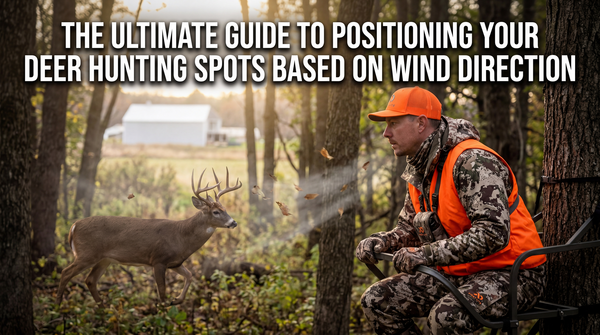
Wind Is Non-Negotiable
You can have the perfect tree, perfect trail, perfect buck sign, and perfect weather.
If your wind is blowing directly into the bedding area, none of that matters.
When scouting, identify which wind directions allow you to hunt each location.
Mark them.
Instead of simply saving:
Spot A
Make your notes useful:
Spot A. Northwest wind. Evening hunt. Enter from the south. Buck bedding northeast.
Now you have an actual hunting plan.
Having several locations for different winds becomes especially important on public land because another hunter might force you to change plans quickly.
Scout Your Entry Route as Hard as Your Stand Location
Hunters will spend hours looking for the perfect tree and almost no time planning how they will reach it.
That is backwards.
Your entry route should be part of your scouting process.
Can you use a ditch to stay hidden?
Can you walk through open ground instead of thick bedding cover?
Can you use a creek for access?
Can you approach from a direction most hunters ignore?
Can you reach the spot without crossing the main deer trail?
Also think about your exit.
This becomes especially important during evening hunts.
If deer are feeding between you and your truck, climbing down and walking directly through them can ruin the area.
Figure that out before you hunt it.
Use Hunting Pressure to Your Advantage
Opening weekend pressure can completely change deer movement on public land.
That does not always have to hurt you.
Hunters entering from predictable parking areas can push deer toward security cover.
If you understand where that security cover is located, hunting pressure can actually make deer movement more predictable.
Study the property and ask:
Where will hunters enter?
Where will they walk?
What cover will deer retreat toward?
What obstacles will hunters avoid?
Is there a funnel between those locations?
The hunter who understands pressure can sometimes benefit from the hunters who do not.
Scout at the Right Time
Different scouting periods accomplish different things.
Post-Season Scouting
Late winter and early spring can be one of the best times to learn a property.
Last season's sign is still visible, vegetation is down, and you can aggressively investigate bedding areas without worrying as much about ruining tomorrow's hunt.
This is when I want to learn the bones of a property.
Walk it.
Find beds.
Follow trails.
Mark rub lines.
Investigate funnels.
Study access.
Summer Scouting
Summer is useful for studying food, glassing fields, running trail cameras where legal, and understanding how vegetation changes the property.
Just remember that summer deer patterns can change dramatically by fall.
In-Season Scouting
During hunting season, scouting should become more surgical.
Now you are looking for current information.
Fresh tracks.
Fresh rubs.
Active scrapes.
Current food.
Recent hunting pressure.
You should have a reason for every step you take.
Do not wander through prime bedding cover just because you are curious.
Know the Rules Before Hunting Public Land
Public land regulations can vary significantly depending on the state, agency, and individual property.
Never assume the rules are identical from one piece of public ground to another.
Before hunting, verify:
- Property boundaries
- Legal hunting dates
- Weapon restrictions
- Parking rules
- Access hours
- Tree stand regulations
- Trail camera regulations
- Baiting regulations
- Camping rules
- Motorized vehicle restrictions
- Blaze orange requirements
- Special permits or drawings
- Retrieval rules
I also use onX Hunt to help identify public and private land boundaries while scouting, especially when I am exploring unfamiliar ground.
Being able to pull out my phone and see property lines in the field is extremely useful.
If you want to use it while scouting your own public land, try onX Hunt free for a week here.
But understand something important.
Do not rely on any hunting app as your only source for legal boundaries, regulations, or access rules.
Always verify information with the appropriate state or public land agency before hunting.
And know exactly where private property begins.
"Close enough" is not good enough when it comes to property boundaries.
Do Not Claim Public Land
Public land belongs to everyone who legally has access to it.
You might scout a spot for months, hang a legal stand, run a camera, and think you have the entire hunt figured out.
Then you might walk in one morning and find another hunter nearby.
That is public land hunting.
Be respectful.
Do not intentionally crowd someone.
Do not mess with another hunter's equipment.
And do not assume someone's tree stand means they own the surrounding woods.
Have backup spots.
The more public land you hunt, the more important this becomes.
One spot is not a strategy.
Have a Plan A, B, C, and D
Never fall in love with one public land hunting spot.
Weather changes.
Wind changes.
Food sources change.
Hunting pressure changes.
Deer change their patterns.
Someone might be parked at your access point when you arrive.
That is why scouting should produce multiple options.
I want spots for different winds, different times of the season, different food sources, and different levels of hunting pressure.
If someone beats me to Spot A, I already know where I am going next.
That keeps you from making bad decisions in the dark at 5:30 in the morning.
My Simple Public Land Scouting Process
If you are new to scouting public land for deer, do not overcomplicate it.
Step 1: E-scout the entire property.
Use onX, satellite imagery, and topographic information to identify access, food, bedding cover, terrain features, water, habitat transitions, and likely hunting pressure.
Step 2: Pick several areas to investigate.
Do not put everything into one location.
Step 3: Put boots on the ground.
Confirm what you saw on the map.
Step 4: Find fresh deer sign.
Look for tracks, droppings, rubs, scrapes, beds, and active trails.
Step 5: Determine where deer are bedding.
You do not necessarily need to locate the exact bed. You need to understand where the security cover is and why deer are using it.
Step 6: Identify travel routes.
Figure out how deer move between bedding, food, and water.
Step 7: Scout hunting pressure.
Determine where other hunters park, walk, and hunt.
Step 8: Plan your access.
Know your entry route, exit route, and acceptable winds.
Step 9: Mark multiple hunting locations.
Give yourself options.
Step 10: Hunt the current information.
When fresh sign tells you something has changed, adapt.
The Biggest Public Land Scouting Mistake
The biggest mistake is looking for a place that looks good instead of trying to understand why deer are there.
Pretty woods do not kill deer.
Fresh information does.
A beautiful open hardwood ridge might be comfortable to sit in, but if every hunter walks through it and mature bucks only visit after dark, it is not doing you much good.
The nasty cattail edge 700 yards away might not look nearly as inviting.
But if it has fresh tracks, security cover, bedding, a good wind advantage, and limited human pressure, that is where I want to spend my time.
Public land hunting rewards hunters who pay attention.
Final Thoughts: Find the Story, Not Just the Sign
When you scout public land for deer, do not simply collect waypoints.
Build a story.
Where is the deer bedding?
Why is it bedding there?
Where is it feeding?
How does it travel between the two?
What terrain influences that movement?
What wind does it prefer?
Where are other hunters entering?
How does hunting pressure change its movement?
And most importantly:
How can you get into position without the deer knowing you are there?
When you can answer those questions, you are no longer wandering through the woods looking for deer sign.
You are hunting with a purpose.
Public land whitetail hunting will humble you. Other hunters will ruin plans. Deer will disappear. The wind will switch. A spot that looked incredible on onX in March might be worthless in October.
Keep scouting.
Keep learning.
Keep finding fresh information.
You do not need hundreds of acres of private ground to become a successful deer hunter.
You need to understand the ground you have access to better than the next guy.