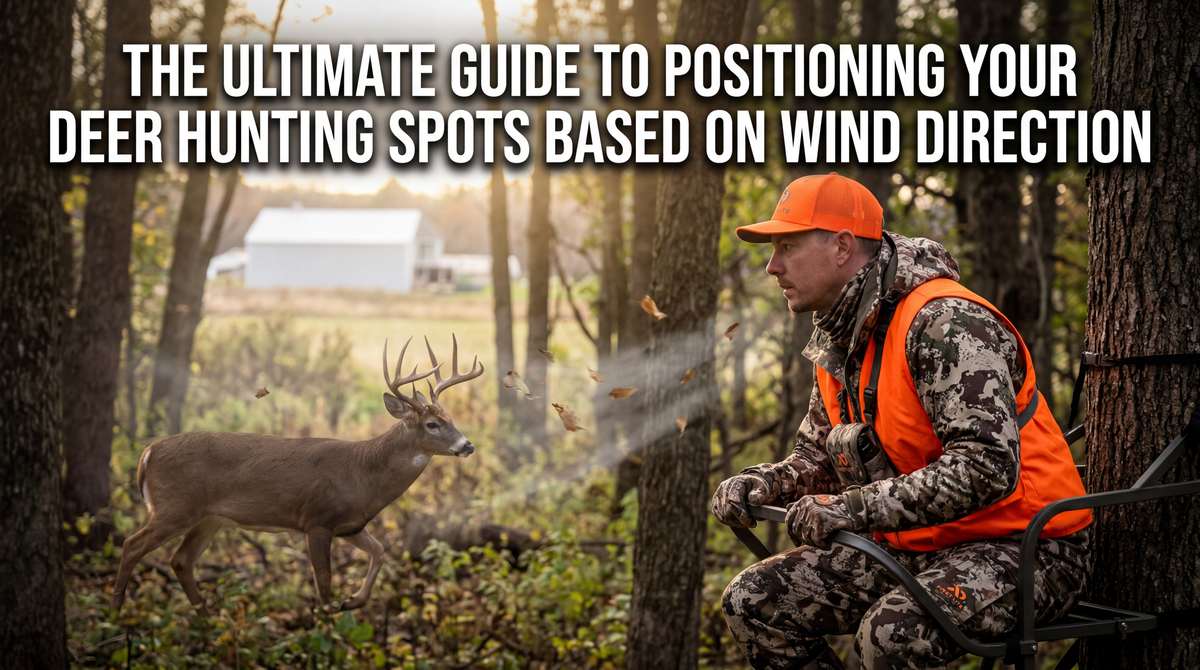
The Ultimate Guide to Positioning Your Deer Hunting Spots Based on Wind Direction
Wind direction is the most important factor in deer hunting success. This guide breaks down how to position tree stands, saddle setups, and blinds based on wind so you stay undetected and increase your chances of killing mature whitetails.

(Tree Stands, Saddle Hunting, and Ground Blinds Explained Simply)
If you take ONE thing seriously in whitetail deer hunting…
make it this:
The wind will make or break your hunt.
You can have the best gear.
The perfect stand.
The biggest buck on camera.
But if your scent hits that deer before you see him…
Game over.
This guide will break down EXACTLY how to position:
- Tree stands
- Saddle setups
- Permanent blinds
…based on wind direction — in the simplest way possible.
Why Wind Direction Matters (Simple Truth)
Whitetail deer live and die by their nose.
A deer’s sense of smell is up to 1,000x stronger than a human’s.
That means:
- They smell danger before they see it
- Before they hear it
- Before you even know they’re there
If your scent cone hits where a deer is coming from, you lose.
What is a “Scent Cone”? (Understand This = Kill More Deer)
Imagine your scent like smoke flowing behind you.
Wherever the wind is blowing, your scent is drifting downwind in a cone shape.
Example:
- Wind blowing North → South
- Your scent is moving South
That means any deer south of you will smell you first.
The Golden Rule of Wind Direction
You NEVER want deer to approach from downwind of you.
Instead:
You want deer:
- Crosswind
- Or slightly upwind
Tree Stand Positioning Based on Wind
Tree stands are the most common — but most hunters get this wrong.
Best Setup: Crosswind Advantage
Let’s say:
- Wind = West → East
You want deer moving:
- North to South (crossing your wind)
Why?
Because:
- Your scent blows past them (not into them)
- You can shoot before they hit your scent stream
This is called a crosswind setup — and it’s highly effective.
Bad Setup: Downwind Exposure
If deer are coming from the direction your wind is blowing…
You’re compromised before the hunt even begins.
Example:
- Wind blowing South
- Deer approaching from South
This setup fails consistently.
Pro Tip: Set Stands for SPECIFIC Winds
Instead of relying on one stand location, have multiple:
- North wind stand
- South wind stand
- East wind stand
- West wind stand
This is one of the biggest differences between average hunters and consistently successful ones.
Saddle Hunting: Using Wind to Your Advantage
Saddle hunting gives you mobility, which is a major advantage.
The Advantage
You can:
- Adjust to wind daily
- Set up based on fresh sign
- Hunt unpredictable deer movement
How to Position
The same rule applies:
Set up where deer move across your wind.
But here’s the added benefit:
You can use terrain and cover to influence deer movement.
Example:
- Bedding area behind you
- Food source ahead
- Wind blowing across that travel route
When positioned correctly, you remain undetected.
Advanced Saddle Strategy
Set up just off the downwind side of bedding areas.
Why?
Because bucks often:
Circle downwind of bedding to scent-check for does.
If your wind is positioned just outside of that path, you can intercept them before they detect you.
Permanent Blinds (Most Misused Setup)
Ground blinds offer comfort, but are often set incorrectly.
Biggest Mistake
Hunters place blinds:
- Directly on food plots
- Directly on trails
…without considering wind direction.
Correct Blind Positioning
Set your blind off to the side of movement.
Then:
- Ensure wind carries your scent away from where deer approach
- Ideally toward:
- Open areas
- Non-travel zones
- Thick cover deer avoid
Proven Blind Strategy
Position your blind:
- 20–40 yards off the main trail
- With wind blowing parallel or slightly away
This allows:
- A clear shot opportunity
- Reduced scent detection
Swirling Winds (The Silent Problem)
Even if wind direction seems correct, swirling winds can ruin a hunt.
Caused by:
- Terrain
- Hills
- Dense timber
- Temperature changes
Areas to Avoid
- Valleys and bottoms
- Tight hollows
- Areas where air stagnates
Better Locations
- Ridges
- Open hardwoods
- Areas with consistent airflow
Thermals (Simple but Critical)
Morning:
Cool air drops, carrying your scent downhill.
Evening:
Warm air rises, carrying your scent uphill.
Example
Morning hunt:
Sit above deer so scent drops away.
Evening hunt:
Sit below deer so scent rises above them.
The Simple Wind Strategy (Remember This)
If you remember nothing else, remember this:
Put your scent where deer are NOT.
Ask yourself:
- Where are deer coming from?
- Where is my scent going?
If those overlap, do not hunt that location.
Real-World Setup Example
Scenario:
- Bedding to the North
- Food to the South
- Wind blowing West → East
Best setup:
Sit on the West side of travel.
Why:
- Wind carries scent East (away from deer movement)
- Deer cross your wind, giving you a shot opportunity
Final Thoughts: Wind is Everything
Most hunters focus on:
- Gear
- Weapons
- Camouflage
But experienced hunters prioritize wind above all else.
If You Want to Kill More Deer This Season
Start doing this:
- Stop hunting favorite spots regardless of conditions
- Hunt based on wind direction
- Move when wind shifts
- Think in terms of scent, not sight
The Truth
You don’t beat a deer’s nose.
You work around it.