Saddle Hunting Ropes Explained: A Beginner's Guide
New to saddle hunting? Understanding your ropes is one of the most important parts of getting started. Learn how tree tethers, lineman's ropes, and bridges work, what to consider when choosing equipment, and which common mistakes to avoid.

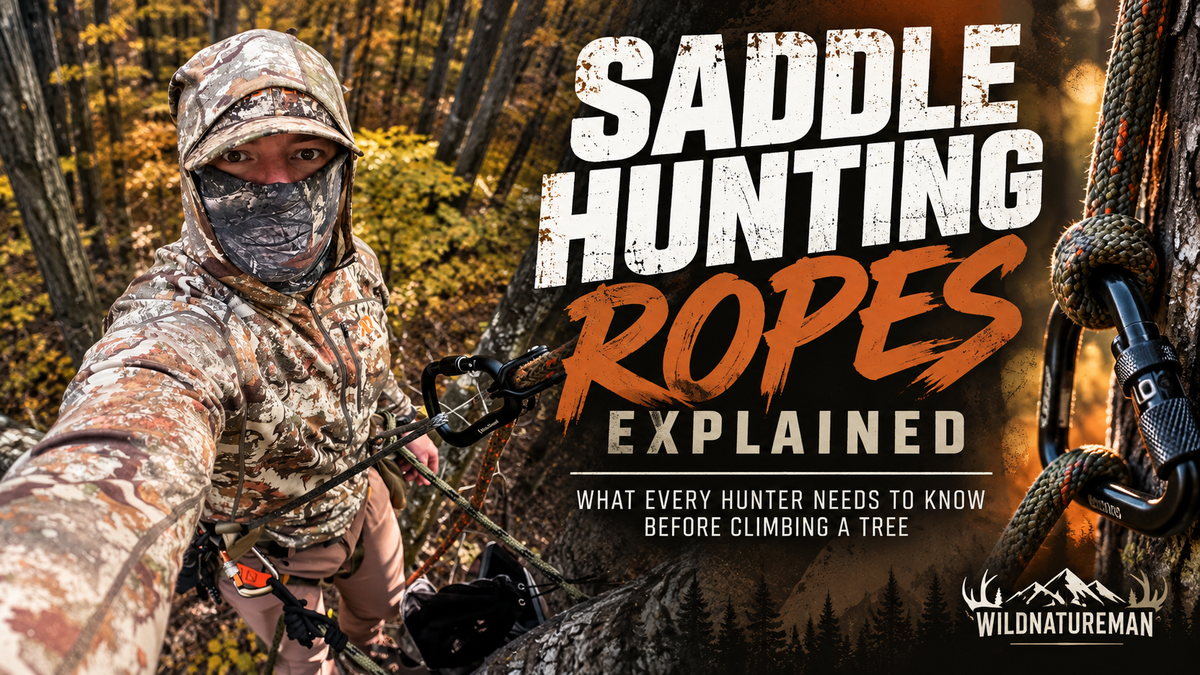
Saddle Hunting Ropes Explained: What Every Hunter Needs to Know Before Climbing a Tree
Saddle hunting has changed the way a lot of deer hunters approach the woods. Instead of hauling a heavy hang-on stand deep into public land or hunting the same tree every weekend, saddle hunters have the freedom to move, adapt, and hunt where the deer actually are.
That freedom is a big reason saddle hunting has become so popular.
But there's one part of saddle hunting that deserves more attention than almost anything else: the ropes.
You can spend hundreds of dollars on the latest lightweight saddle, carbon climbing sticks, and fancy platforms. None of that matters if you don't understand the equipment responsible for keeping you attached to the tree.
And if you're new to saddle hunting, the terminology alone can be confusing.
Tethers, lineman's ropes, bridges, Prusik knots, mechanical ascenders, rappel ropes. What does all of it mean? Do you actually need all of it? And how do you know which rope is right for your setup?
Let's break it down.
Why Your Saddle Hunting Ropes Matter
When most hunters start researching saddle hunting, they naturally focus on the saddle itself.
Is it comfortable? How much does it weigh? Can I sit in it for six hours? Is it going to pinch my hips?
Those are reasonable questions.
But your saddle is only one part of a complete system.
Your ropes and connectors are what keep you attached to the tree while climbing, transitioning into your hunting position, and eventually descending.
A good saddle hunting setup isn't necessarily the lightest or most expensive. It's one that you understand, can operate consistently, and know how to use safely.
There is no room for guessing when you're 20 feet off the ground.
The Three Main Ropes Every Saddle Hunter Should Understand
There are three primary rope components worth understanding before your first climb.
1. The Lineman's Rope: Your Climbing Connection
The lineman's rope, sometimes called a lineman's belt, is generally used while climbing and installing equipment.
It wraps around the tree and connects to the designated lineman's attachment points on your saddle.
The purpose is to help keep you connected to the tree while allowing you to work with your climbing sticks and platform.
Think about everything you're doing during a climb.
You're moving your feet, reaching for climbing sticks, adjusting equipment, and navigating the tree itself.
Your attention is divided between several tasks.
That's exactly why understanding your climbing connection matters.
Important: A lineman's rope alone is not a substitute for a fall-arrest system or continuous fall protection. Slack, positioning, and climbing transitions can create serious fall hazards. Follow your saddle manufacturer's instructions for maintaining approved protection throughout the climb.
2. The Tree Tether: Your Hunting Connection
Once you reach hunting height, the tree tether becomes one of the most important components of your setup.
The tether connects your saddle's bridge to an approved anchor around the tree.
This is what supports you while you're positioned on your hunting platform.
Unlike a traditional treestand, where you're primarily standing or sitting on a fixed structure, a saddle allows you to lean or sit while remaining connected to the tree.
That creates some interesting advantages.
You can adjust your body position, use the tree for concealment, and maneuver around the trunk to prepare for different shooting opportunities.
But all of those movements depend on properly functioning equipment.
Your tether, bridge, carabiner, and adjustment system must work together as an approved combination.
Never assume that because two pieces of equipment physically connect, they're compatible.
3. The Bridge Rope: The Connection on Your Saddle
The bridge is the rope or webbing connection that spans the designated bridge attachment points on your saddle.
It connects to your tether system and helps distribute your weight while suspended.
Some saddles come with fixed bridges. Others have manufacturer-approved adjustable bridges.
Bridge length can influence comfort, body position, and how the saddle feels around your hips.
However, modifying bridge length or replacing a bridge isn't something to experiment with casually.
Use the manufacturer's approved bridge configuration and adjustment instructions.
The bridge is a life-support component, not an accessory.
What About Rappel Ropes?
Rappelling is another topic you'll encounter when researching saddle hunting.
Some hunters use specialized systems that allow them to descend the tree on a rope instead of reversing their climbing method.
It can sound appealing, particularly for mobile hunters looking to simplify their descent.
But rappelling introduces additional equipment, techniques, and risks.
A rappel system may require a specifically rated rope, compatible descent-control device, appropriate connectors, and a properly designed anchor.
Not every saddle hunting tether is suitable for rappelling, and not every rope works with every descent device.
Before considering a rappel setup, get qualified instruction and follow the equipment manufacturers' requirements.
This is not an area where watching one YouTube video makes someone proficient.
Rope Diameter: Does Bigger Mean Safer?
One of the first things you'll notice when shopping for saddle hunting ropes is the variety of diameters.
You'll see products advertised in sizes such as 8 mm, 9 mm, 10 mm, and 11 mm.
Naturally, it's tempting to assume that the thickest rope is automatically the strongest and safest.
That's not necessarily true.
Rope performance depends on several factors, including:
- Fiber materials and rope construction
- Manufacturer-rated strength and intended use
- Abrasion resistance and durability
- Compatibility with friction hitches or mechanical devices
- Approved terminations and connection methods
- Condition, age, and exposure to damage
A smaller-diameter rope can have a higher published breaking strength than a larger rope because of differences in materials and construction.
However, breaking strength is not the same as an approved working load or a complete system's safety rating.
And perhaps most importantly, a rope's diameter must fall within the approved range for the specific mechanical device or friction-hitch system you're using.
Don't choose rope based on diameter alone.
Prusik Knots vs. Mechanical Ascenders
Another major decision involves how your rope adjustment system works.
Many saddle hunting systems use friction hitches, while others incorporate mechanical adjustment devices.
Prusik Knots and Friction Hitches
A Prusik is a type of friction hitch that grips a rope when loaded and can be repositioned under appropriate conditions.
Friction hitches have been used in rope-access and climbing applications for years.
They're relatively simple in concept, but that doesn't mean any combination of cord and rope will work.
The hitch cord, host rope, materials, diameters, and configuration all affect performance.
A poorly matched friction hitch may slip, bind, or behave unpredictably.
Use only the hitch system specified or approved by your equipment manufacturer.
Mechanical Ascenders and Adjusters
Mechanical devices are popular because certain models can make rope adjustments more convenient.
You may hear hunters discussing devices such as the Ropeman or Kong Duck.
These devices aren't interchangeable, and their limitations can differ significantly.
Each model has specific requirements for rope diameter, rope construction, loading direction, and intended application.
Some devices are not approved for fall arrest, shock loading, or particular saddle hunting configurations.
Before adding one to your setup, verify compatibility with both the rope manufacturer and the device manufacturer.
Convenience should never be the deciding factor when selecting life-support equipment.
Common Saddle Hunting Rope Mistakes
There's a lot of information online about saddle hunting, and not all of it comes from qualified instructors or equipment manufacturers.
Here are several mistakes worth avoiding.
Mixing Equipment Without Checking Compatibility
Just because a rope fits through a mechanical device doesn't mean that combination is approved.
The same applies to carabiners, friction hitches, bridges, and other connectors.
Using Hardware Store Rope
General-purpose rope, utility cord, and paracord are not substitutes for approved life-safety equipment.
Use components specifically rated and approved for their intended application.
Ignoring Rope Wear
Ropes experience friction, bending, dirt, moisture, and abrasion.
Inspect your ropes and other life-support components before every use according to the manufacturer's instructions.
Look for damaged fibers, unusual stiffness, cuts, glazing, chemical exposure, and other signs of deterioration.
If you discover questionable damage, remove the equipment from service until the manufacturer or another qualified authority determines whether it is safe.
Practicing for the First Time During a Hunt
The morning of opening day is not the time to learn your rope system.
Practice with qualified instruction in a controlled environment at ground level before attempting an elevated climb.
Learn the equipment until its operation is familiar and repeatable.
Getting Too Comfortable
Familiarity can lead to shortcuts.
That can be especially dangerous during climbing and transitions, when hunters may be focused on placing equipment rather than maintaining fall protection.
Develop a routine that follows your manufacturer's safety procedures every time.
How to Choose Saddle Hunting Ropes
If you're new to saddle hunting, my suggestion is to keep things simple.
Start with a complete, manufacturer-approved rope system designed to work with your specific saddle.
A basic system generally includes a lineman's rope and tree tether, while the saddle itself includes an approved bridge.
Make sure you understand the intended purpose of each component.
Before buying, consider the following questions:
- Is this rope specifically approved for its intended saddle hunting application?
- Is it compatible with my saddle, connectors, and adjustment devices?
- Does the manufacturer provide clear instructions and safety warnings?
- What are the inspection, maintenance, and retirement requirements?
- Do I have access to qualified instruction for using the complete system?
You don't need to purchase every accessory available.
You need a dependable, compatible system and the knowledge to use it correctly.
A Few Thoughts for Michigan Public Land Hunters
One of the biggest advantages of saddle hunting is mobility.
Here in Michigan, we have some incredible opportunities to hunt public land, but finding the right spot often requires a willingness to move.
Maybe you discover a fresh rub line farther down a ridge.
Maybe the deer are crossing a creek bottom instead of following the trail you originally expected.
Or maybe the tree you planned to hunt isn't suitable once you actually get there.
Being mobile gives you options.
But mobility shouldn't mean sacrificing safety for speed or saving a few ounces.
If you're walking a mile into public land before daylight, your setup needs to be something you understand and can operate confidently.
And sometimes the right decision is to hunt from the ground rather than climb a tree that isn't suitable for your equipment.
The goal isn't simply to get higher or farther into the woods.
It's to hunt effectively and return home safely.
Final Thoughts: Know Your Ropes Before You Trust Them
Saddle hunting opens up a different way to experience the woods.
It's mobile, versatile, and gives hunters opportunities that might be difficult with a traditional treestand.
But there's a learning curve.
And understanding your ropes is one of the most important parts of that learning process.
Know the difference between your lineman's rope, tether, and bridge. Understand how your approved connections work. Inspect your equipment. Practice with qualified instruction. And don't assume something is safe just because you've seen someone doing it online.
Your ropes aren't just another piece of hunting gear. They're part of the system responsible for getting you home.
Stay safe, hunt smart, and enjoy the woods.
WildNatureMan
Safety disclaimer: This article is educational and is not a substitute for hands-on instruction, manufacturer-approved procedures, or a complete fall-protection plan. Always follow the current instructions for your exact saddle, rope, connectors, and climbing system.