Michigan Deer Hunting Changes: What Hunters Need to Know for 2026 and 2027
Michigan deer hunters are facing some of the biggest regulation changes in years. Here is a plain-English breakdown of the eliminated rifle line, the coming one-buck limit and the earn-a-second-buck pilot—and what each change means in the woods.

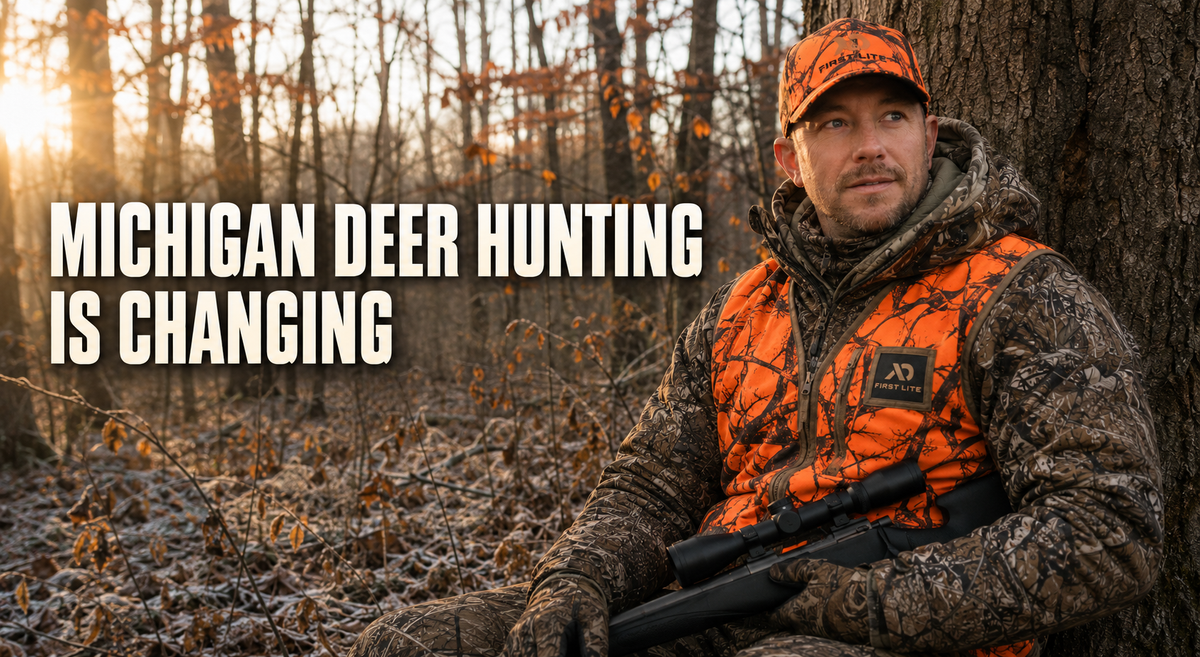
Michigan deer hunters are heading into a stretch of change that will reshape what guns we can carry, how many bucks we can legally take and, in a handful of counties, what we may have to do before earning an opportunity at a second buck.
Some hunters are excited. Some are frustrated. Plenty are still trying to figure out exactly what changed and when it takes effect.
That last part matters because two major changes are being discussed at the same time, but they do not begin in the same year. The elimination of the Lower Peninsula’s limited-firearms zone begins with the 2026 season. The statewide Lower Peninsula one-buck limit and the earn-a-second-buck pilot begin in 2027.
After listening to Michigan native and MeatEater Director of Conservation Mark Kenyon discuss the changes, I kept coming back to one thought: whether we like every decision or not, we need to understand the rules, hunt safely and think beyond our own tag.
Here is the plain-English version.
The Southern Michigan “Rifle Line” Is Gone for 2026
For decades, Michigan hunters understood that crossing into southern Lower Michigan meant different firearm restrictions. What many of us still called the “shotgun zone” later became the limited-firearms deer zone, allowing certain straight-walled cartridges and other legal firearms while continuing to restrict traditional bottleneck rifle cartridges.
Beginning September 12, 2026, that limited-firearms zone is eliminated. Hunters may use all otherwise legal firearms throughout the Lower Peninsula. That means cartridges such as the .308 Winchester, .30-06 Springfield and 6.5 Creedmoor can now be legal options in areas where hunters previously relied on shotguns, muzzleloaders or straight-walled cartridges.
The change gives hunters more freedom, but freedom does not make every firearm appropriate for every property.
A rifle capable of reaching several hundred yards may be legal on paper and still be a poor choice for a small parcel surrounded by homes, roads, livestock or neighboring hunters. Southern Michigan includes a patchwork of farms, subdivisions, woodlots and narrow private parcels. A bullet does not recognize a property line.
Before carrying a new rifle into the woods, every hunter should:
- Know the target and what is beyond it.
- Use a solid backstop and favor downward shooting angles whenever possible.
- Confirm the firearm is legal for the season and location being hunted.
- Sight in with the exact ammunition that will be carried afield.
- Understand the cartridge’s trajectory, effective range and retained energy.
- Avoid taking a shot simply because the rifle is technically capable of making it.
Kenyon’s point about stewardship is the right one. Access to more capable equipment puts more responsibility—not less—on the person behind the trigger. One careless incident can damage public trust in hunting far beyond the property where it happened.
Michigan’s One-Buck Limit Begins in 2027
The second major change does not affect the 2026 deer season. Beginning in 2027, hunters in the Lower Peninsula will generally be limited to one antlered deer unless they qualify for a second through the new pilot program.
That is a significant cultural shift in a state where many hunters have traditionally purchased a combination license and entered the season with two buck tags.
The goal is not simply to take opportunity away. Michigan has a deer-distribution problem. In parts of the Lower Peninsula, especially areas with abundant private land, agriculture and suburban cover, antlerless deer numbers can be high. At the same time, hunters often place more pressure on bucks than does.
A one-buck limit may change hunter behavior. Someone who previously shot the first legal buck they saw because another buck tag remained may become more selective. If more young bucks survive an additional season, hunters could eventually see more mature animals and a better-balanced buck age structure.
That outcome is possible, but it is not automatic. Regulation changes cannot replace habitat work, private-land access, responsible doe harvest or cooperation between neighboring landowners. Deer management happens property by property as much as it happens in Lansing.
How Michigan’s Earn-a-Second-Buck Pilot Will Work
Michigan’s earn-a-second-buck program is scheduled to begin in 2027 as a pilot—not a blanket statewide rule.
The five treatment counties are:
- Barry County
- Hillsdale County
- Ingham County
- Kalamazoo County
- Lapeer County
Hunters who choose the earn-a-second-buck license product must harvest and report an antlerless deer in one of those counties before becoming eligible to purchase the bonus tag. The bonus tag may then be used for a second buck that meets the applicable restriction, including a four-point antler requirement on one side during the regular seasons covered by the order.
The important word is choose. Based on the adopted framework, hunters must select the earn-a-second-buck license product when purchasing their license. It is not something to casually decide after shooting a doe or after using the first buck tag.
The DNR paired the five pilot counties with comparison counties and plans to study whether the rule actually increases antlerless harvest. That matters. Earn-a-buck ideas sound simple around a campfire, but hunter access, deer density, disease, crop damage and local hunting pressure are anything but simple. A pilot allows the state to measure results before deciding whether the idea should expand.
Hunters planning to participate in 2027 should review the final license details before buying anything. The program involves specific tags, reporting requirements, qualifying counties and antler-point rules. Do not rely on a social-media post—or even this article—as a substitute for the current Michigan hunting digest.
Will These Changes Improve Michigan Deer Hunting?
Maybe—but the answer depends on what hunters do next.
Eliminating the rifle line may make firearm rules simpler and give hunters more equipment choices. It could also create unnecessary risk if people confuse legal range with ethical range.
The one-buck limit could allow more young bucks to reach older age classes. It could also frustrate hunters who value the traditional two-buck opportunity or hunt primarily for venison.
The earn-a-second-buck pilot could increase doe harvest in targeted counties. But it will only work if hunters can access properties holding antlerless deer and are willing to use that opportunity. A rule cannot make a landowner grant permission, and it cannot make deer appear on heavily pressured public ground.
For me, the best response is neither blind support nor automatic outrage. Ask whether the regulation solves the problem it claims to solve. Watch the harvest data. Share honest field observations. Attend Natural Resources Commission meetings or submit comments. Most importantly, remember that deer management and hunting culture belong to all of us.
What Michigan Deer Hunters Should Do Now
For the 2026 season, confirm the firearm rules for the land you hunt, sight in early and make sure every member of deer camp understands that the old southern rifle line is gone—but the basic rules of safe shooting have not changed.
For 2027, start thinking about whether the one-buck limit will change your personal harvest strategy. If you hunt in Barry, Hillsdale, Ingham, Kalamazoo or Lapeer County, learn the earn-a-second-buck requirements before purchasing your license.
And wherever you hunt, have a real conversation with neighboring landowners. Are deer numbers too high, too low or simply uneven? Are you seeing enough does? Are young bucks being passed? Is habitat improving? The state can set the framework, but hunters and landowners create the outcome.
Michigan deer hunting has never stood still. Seasons, equipment and management strategies have always evolved. The challenge is making sure we move forward without losing the responsibility, tradition and respect for the resource that brought us into the woods in the first place.
The rules may be changing. Our duty as hunters is not.