
A House Divided Cannot Stand: America Is Losing Its Soul
“A house divided against itself cannot stand.” — Matthew 12:25. America is consumed by political outrage, division, and distraction. Who benefits from the chaos? Why do we keep participating? It's time to question the narrative, think independently, and reclaim what matters.

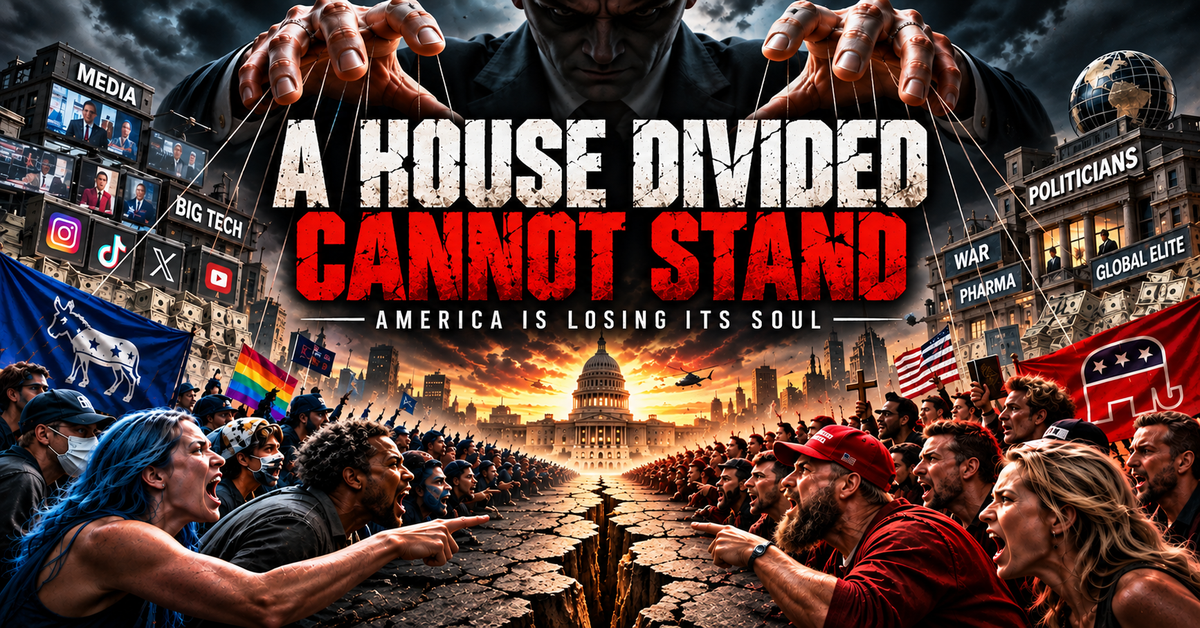
We have never been more connected, more informed, or more technologically advanced. So why are we so angry, divided, distracted, and disconnected from what actually matters?
“Every kingdom divided against itself is brought to desolation; and every city or house divided against itself shall not stand.” — Matthew 12:25 (KJV)
Read that again.
Two thousand years ago, Jesus Christ spoke words that should make every American uncomfortable today.
A house divided against itself cannot stand.
Not a Republican house.
Not a Democratic house.
Not a conservative house or a liberal house.
ANY house.
And yet here we are, living in a country where nearly everything has become an excuse to hate one another.
Red versus blue. Black versus white. Rich versus poor. Men versus women. Straight versus gay. Religious versus secular. Traditional values versus progressive ideals.
Pick a side. Choose your enemy. Defend your team.
And whatever you do, don't question the narrative.
What the fuck happened to us?
Somewhere along the way, we stopped being neighbors, friends, fathers, mothers, brothers, sisters, and fellow Americans.
We became political identities.
And while we're busy fighting one another, there's an uncomfortable question almost nobody seems willing to ask:
Who benefits from a divided America?
1. When Did Politics Become a Fucking Team Sport?
Seriously.
When did politics become something we cheer for like Sunday afternoon football?
When did defending a politician become more important than defending our own principles?
When did criticizing someone from your political party become an act of betrayal?
Watch what happens when a politician says something outrageous.
If they're on the opposing team, people demand accountability.
If they're on our team, people rush to explain why it wasn't actually that bad.
Same behavior. Different standards.
That's not conviction.
That's tribalism.
And tribalism is a dangerous substitute for independent thought.
We've turned politicians into celebrities, political parties into identities, and elections into championship games.
Except here's the difference:
When your football team loses, you go to work Monday morning. When political decisions go wrong, families can spend years living with the consequences.
Your mortgage doesn't care which political party you support.
Your grocery bill doesn't care how many political arguments you've won online.
Your children don't care how many political commentators you've successfully defended.
They care whether there's food on the table, whether they feel safe, and whether their parents are present.
Yet we've somehow convinced ourselves that being politically engaged requires being perpetually furious.
It doesn't.
You can care deeply about your country without turning your neighbor into your enemy.
2. Who Actually Benefits From All This Division?
Follow the incentives.
Not every disagreement is manufactured. Not every headline is fabricated. Not every political controversy is some coordinated conspiracy.
But make no mistake: there is money to be made from keeping people angry.
Political campaigns raise money by convincing supporters that everything is at stake.
News organizations compete for attention in a crowded information market.
Social media platforms benefit when users remain engaged.
Influencers build entire careers around provoking reactions.
And outrage is exceptionally effective at capturing human attention.
Think about your own experience.
How often do you open social media intending to spend five minutes checking something, only to find yourself twenty minutes deep into an argument about something that has absolutely no bearing on your daily life?
Something a politician said.
Something a celebrity posted.
Something someone did in a video.
Something designed to make you react.
You get angry.
You comment.
Someone disagrees.
You argue.
And the cycle continues.
Meanwhile, the platforms collect engagement, the content creators gain attention, and you're left carrying around anger that wasn't there twenty minutes earlier.
You didn't gain wisdom. You gained another reason to be pissed off.
And tomorrow, the process repeats.
That doesn't mean there's a single mastermind controlling everything.
It means a system can produce destructive outcomes when its incentives reward destructive behavior.
And we need to be intelligent enough to recognize the difference.
3. The Most Important Election of Our Lifetime. Again.
How many times have you heard it?
"This is the most important election of our lifetime."
"Democracy is on the line."
"Everything changes if the other side wins."
"Get out and vote before it's too late."
Different year.
Different candidates.
Same urgency.
Now, elections absolutely matter. Policies matter. Leadership matters. Civic participation matters.
But at what point do we recognize that perpetual political panic is exhausting the very people government is supposed to serve?
We're told to be afraid.
We're told to be angry.
We're told the opposing party is destroying America.
And we're told that the next election will somehow fix everything.
Then the election ends.
Life continues.
Bills arrive.
Groceries cost money.
Families still struggle.
And the political machine immediately begins preparing for the next fight.
The government was established to serve the people. The people were not created to spend their lives worshipping the government.
We should be demanding competence, transparency, accountability, and results.
Instead, too often, we're busy defending personalities.
The question shouldn't simply be whether our political party won.
It should be whether our communities are stronger, whether our families can thrive, whether our freedoms are protected, and whether our institutions are fulfilling their responsibilities.
Those questions are far more important than winning an argument on the internet.
4. Matthew 12:25: The Warning We Keep Ignoring
Let's return to the Bible.
Matthew 12:25 reads:
“Every kingdom divided against itself is brought to desolation; and every city or house divided against itself shall not stand.”
Understanding the context matters.
In Matthew 12, Jesus responds to accusations that He casts out demons through the power of Beelzebub.
His response exposes the contradiction in that accusation.
Why would Satan cast out Satan?
How could a kingdom survive if it were actively working against itself?
Jesus was making a logical argument about internal division.
He wasn't delivering a modern American political speech.
But the principle is timeless.
A house consumed by internal conflict eventually destroys its own foundation.
A marriage cannot flourish when husband and wife treat each other as enemies.
A family cannot thrive when resentment replaces love.
A community cannot prosper when distrust consumes every relationship.
And a nation cannot remain healthy when its citizens increasingly view one another as threats rather than fellow human beings.
Disagreement is not the problem.
Disagreement is inevitable in a free society.
The problem begins when disagreement becomes hatred.
When political identity becomes more important than truth.
When winning becomes more important than understanding.
When we stop seeing the humanity in people who think differently.
That's when the walls begin to crack.
And perhaps the most disturbing part is that we can watch those cracks spreading while still insisting that the people on the other side are entirely responsible.
5. The Church Has Its Own House to Clean
Now comes the part that might make some Christians uncomfortable.
I believe in God.
I believe in Jesus Christ.
I believe the Bible contains extraordinary wisdom about human nature, morality, responsibility, forgiveness, and the way we should live.
But believing in Christ does not mean blindly defending every institution operating under His name.
The Bible is not a political party. Jesus Christ is not a campaign mascot. And Christianity should never become a business model built around fear, money, and manipulation.
Look at the Gospels.
Jesus confronted religious hypocrisy directly.
In Matthew 23, He condemned religious leaders who emphasized outward righteousness while neglecting justice, mercy, and faithfulness.
He challenged those who placed burdens on others while refusing to live by the same standards.
He exposed the difference between appearing holy and actually living faithfully.
And those warnings remain relevant.
A church can preach humility while its leadership pursues status.
A religious institution can preach generosity while prioritizing its own wealth.
A spiritual leader can preach accountability while refusing to accept personal responsibility.
None of that means every church is corrupt.
Many churches and religious communities do extraordinary work serving people.
But corruption becomes especially destructive when it hides behind the authority of God.
The failure of a religious institution is not the failure of Jesus Christ.
And questioning religious hypocrisy is not the same as rejecting faith.
In fact, honest accountability may be one of the most faithful things we can demand.
I don't want faith that requires me to stop asking questions.
I want faith strong enough to withstand them.
6. We Have More Information Than Ever, Yet We Struggle to Think for Ourselves
Consider the absurdity of modern life.
We carry devices in our pockets capable of accessing an unimaginable amount of human knowledge.
History. Philosophy. Scripture. Science. Literature. Research.
All available within seconds.
Yet how much of our time do we spend consuming arguments, gossip, sensational headlines, and thirty-second clips stripped of context?
We have confused information with understanding.
Popularity with credibility.
Confidence with intelligence.
And having an opinion with actually knowing something.
Someone publishes a provocative headline.
Thousands of people react without reading the article.
Someone shares a clip.
Millions form opinions without seeing the complete conversation.
Someone makes an accusation.
The accusation spreads faster than the evidence can be examined.
And before long, people are defending positions they haven't even taken the time to understand.
We're not suffering from a lack of information. We're suffering from a lack of discernment.
And discernment requires something modern culture rarely encourages.
Patience.
Humility.
Curiosity.
The willingness to admit we might be wrong.
When was the last time you genuinely changed your mind about something important?
When was the last time you listened to someone you disagreed with, not to prepare your response, but to understand their perspective?
When was the last time you read beyond the headline?
Or questioned a story that supported your existing beliefs?
It's easy to challenge the other side.
The real test of independent thinking is whether you're willing to challenge your own.
7. We're Living in a Matrix of Distraction
I don't mean we're literally living inside a computer simulation.
I mean we've constructed a world where enormous portions of our attention are consumed by narratives, digital arguments, artificial urgency, and conflicts that never seem to end.
Wake up.
Check the phone.
Read the headlines.
Get angry.
Go to work.
Check the phone again.
Another controversy.
Another argument.
Another reason to believe the world is falling apart.
Come home.
Scroll some more.
Go to bed.
Repeat.
What kind of fucking existence is that?
We're alive on a planet filled with mountains, forests, rivers, oceans, wildlife, extraordinary people, and experiences most of us will never have enough time to enjoy.
Yet we voluntarily spend countless hours staring into glowing rectangles, allowing strangers to dictate our emotional state.
Think about that.
You have one life.
One opportunity to raise your children.
One opportunity to build meaningful relationships.
One opportunity to experience this incredible world.
And somewhere, someone you've never met can ruin your entire afternoon with a political opinion.
That's not freedom.
That's surrendering control of your attention.
And your attention is one of the most valuable things you possess.
8. Go Outside. The World Is Still Real.
This is where I believe we've lost something fundamental.
We've become disconnected from the physical world.
From nature.
From silence.
From the experience of simply being alive.
Go sit in the woods before sunrise.
Listen to the wind moving through the trees.
Watch the forest come alive.
Listen to birds calling from the canopy.
Feel the cold air on your face.
Watch the sun break over the horizon.
Out there, the noise of modern life begins to disappear.
The deer don't care which political party won the election.
The trees aren't arguing about the latest controversy.
The river isn't checking social media to decide whether it should be angry.
Nature continues.
Life continues.
And for a moment, you're reminded that the world is much bigger than the narratives competing for your attention.
That's one of the reasons I love the outdoors.
Hunting. Hiking. Running. Exploring public land. Sitting in silence.
Not because the world's problems disappear.
But because stepping away gives me the perspective to recognize what actually matters.
Sometimes the most rebellious thing you can do in a culture addicted to distraction is put your phone down and go live your life.
Be present with your wife.
Play with your children.
Call your parents.
Help your neighbor.
Go fishing.
Walk through the woods.
Read the Bible.
Build something with your hands.
Pray.
Think.
Live.
Not everything meaningful needs to be photographed, posted, debated, monetized, or turned into content.
Some of the best moments of your life will happen when nobody else is watching.
9. You Can Have Convictions Without Hating People
Let me make something absolutely clear.
I am not advocating for a world without convictions.
Quite the opposite.
Believe in something.
Stand for something.
Have principles.
Defend your family.
Practice your faith.
Speak the truth as you understand it.
And have the courage to stand alone when necessary.
But understand the difference between conviction and hatred.
You can believe strongly in traditional values without treating people who live differently as less human.
You can disagree with someone's political beliefs without questioning their worth as a person.
You can reject an ideology without despising every person associated with it.
You can be a Christian without behaving as though everyone who disagrees with you is your enemy.
In Matthew 22:39, Jesus commands us to love our neighbors as ourselves.
Not just the neighbors who vote like us.
Not just the neighbors who look like us.
Not just the neighbors who share our religious beliefs.
Our neighbors.
Love does not require agreement. Respect does not require surrendering your principles.
And strength is not measured by how loudly you can insult someone.
Real strength includes the discipline to remain grounded when everyone around you is losing control.
That's a form of courage we desperately need more of.
10. The Greatest Threat May Be What We're Becoming
Maybe the most important question isn't whether Republicans or Democrats are responsible for the condition of America.
Maybe it's what this endless conflict is doing to us.
Are we becoming more compassionate?
More thoughtful?
More honest?
More capable of raising strong families and building healthy communities?
Or are we becoming more suspicious, more resentful, more distracted, and more willing to hate people we've never met?
Are we teaching our children to think critically?
Or are we teaching them to inherit our enemies?
Are we building a better society?
Or are we simply becoming more skilled at blaming one another for its problems?
Because there's something deeply troubling about a culture that claims to value freedom while constantly demanding ideological conformity.
There's something disturbing about people who preach tolerance while refusing to tolerate disagreement.
And there's something profoundly hypocritical about defending morality in public while abandoning it in private.
We cannot demand integrity from our leaders while refusing to practice it ourselves.
We cannot condemn hatred while celebrating it when directed at the people we dislike.
We cannot demand truth while willingly spreading information we haven't verified.
And we cannot complain about division while actively contributing to it every single day.
At some point, responsibility has to become personal.
11. The Way Forward Starts With Us
I don't believe the solution to America's division will come from another political slogan.
Or another celebrity endorsement.
Or another viral argument.
And I certainly don't believe any single politician can repair the cultural damage we've allowed to develop.
The solution begins much closer to home.
It begins with fathers and mothers taking responsibility for the values they teach their children.
With people becoming informed instead of merely outraged.
With neighbors choosing conversation over contempt.
With Christians demonstrating their faith through their actions rather than simply announcing it through their words.
With communities demanding accountability from institutions without abandoning the importance of those institutions.
With individuals refusing to surrender their identities to political tribes.
And with each of us recognizing that our time on this earth is finite.
You don't get these years back.
You don't get your children's childhood back.
You don't get the hours spent consumed by meaningless arguments back.
And when your life is coming to an end, I doubt you'll wish you'd spent more time defending politicians on the internet.
You'll wish you had more time with the people you love.
More mornings watching the sunrise.
More conversations that mattered.
More opportunities to help someone.
More moments when you were fully present.
The greatest wealth in this life isn't political power, social status, or the approval of strangers.
It's the ability to live with purpose, conviction, gratitude, and love.
And no political party owns those things.
Final Thoughts: A House Divided Cannot Stand
Matthew 12:25 is not a convenient slogan for attacking political opponents.
It's a warning about the destructive nature of internal division.
And perhaps that's why it remains so powerful.
Because it forces us to look beyond the people we blame and examine the ways we contribute to the very problems we condemn.
We don't need to agree on everything.
We never will.
But we do need to remember that disagreement doesn't make someone our enemy.
That government should be accountable to the people.
That faith should produce humility rather than arrogance.
That truth matters more than tribal loyalty.
And that life is far too short to spend it perpetually furious at people we've never met.
STOP WORSHIPPING POLITICIANS.
STOP LETTING STRANGERS CONTROL YOUR EMOTIONS.
STOP CONFUSING OUTRAGE WITH PURPOSE.
STOP ALLOWING POLITICAL IDENTITY TO REPLACE YOUR OWN MORAL COMPASS.
Go outside.
Spend time with your family.
Read something that challenges you.
Question what you're told.
Practice what you preach.
Have the courage to think independently.
And remember the words of Jesus Christ:
“Every kingdom divided against itself is brought to desolation; and every city or house divided against itself shall not stand.” — Matthew 12:25
Two thousand years later, the warning still stands.
The question isn't whether we can identify the cracks in our house.
The question is whether we're willing to stop tearing it apart.
Wild Nature Man is about more than hunting, wildlife, and the outdoors. It's about living deliberately, thinking independently, building strength, practicing faith, and reconnecting with the things that matter most.
What do you think? Is America's division being amplified by the systems competing for our attention, or have we simply forgotten how to disagree with one another? Share your perspective.